


Reishi
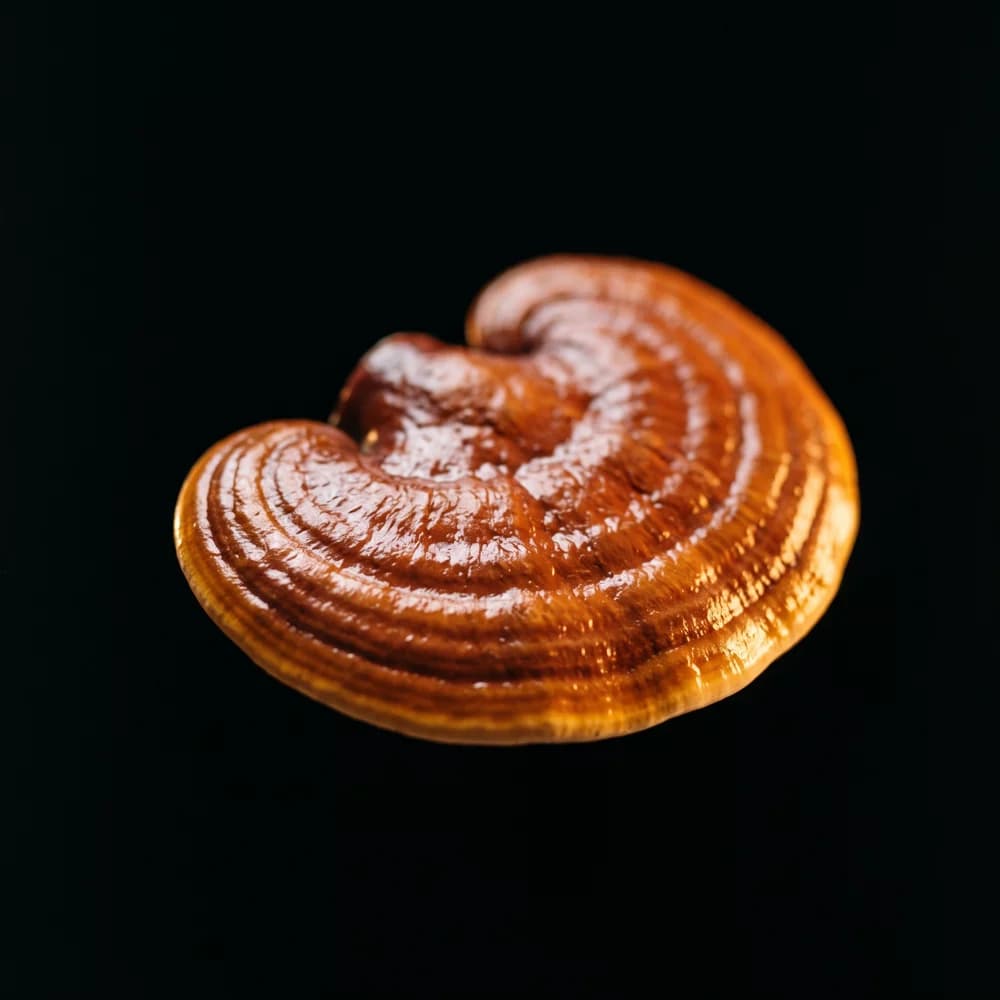
Reishi (Ganoderma lucidum) is called the 'mushroom of immortality' in Traditional Chinese Medicine. Bitter and woody, it is one of the best-known and most-studied medicinal mushrooms.
Ganoderma lucidum
- 01
What reishi is
Reishi is a wood-decay mushroom growing on hardwood trees. In tradition it is dried and extracted, because its hard fruiting body cannot be eaten raw – the active compounds are released only by water and alcohol extraction.
- 02
Traditional use
In Asian tradition reishi has been used for centuries for calm, balance and overall vitality. It is considered an adaptogen – a mushroom associated with coping with everyday strain.
- 03
What science studies
Reishi is among the most studied mushrooms. Research focuses mainly on its triterpenes and beta-glucans and on how the body recognises their structure. It is a food ingredient, not a medicine.
- 04
Key compounds
Characteristic are triterpenes (ganoderic acids – the source of the bitterness) and 1,3/1,6 beta-glucans from the cell walls. It is their combination that makes reishi unique.
Where science sees potential
- calm and sleep quality
- immune system balance
- antioxidant cell protection
What studies have shown
Wachtel-Galor S. et al., 2011 (Herbal Medicine, CRC Press)
review of reishi's bioactive triterpenes and polysaccharides and research directions
Gao Y. et al., 2003, Immunol Invest
reishi polysaccharides and modulation of immune-cell activity
This concerns research on the mushroom and its compounds, not a claim that a food supplement treats disease. Many findings come from laboratory or smaller studies.
FAQ
- How does reishi taste?
- Distinctly bitter and woody – a sign of a true fruiting body. In our products it is balanced by honey.
- When to take reishi?
- Traditionally it is associated more with the evening and calm. Dosage is on each product page.