


 BIO
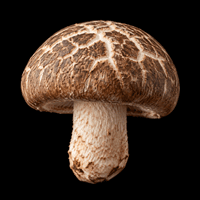
Shiitake
Shiitake is the world's second most-cultivated mushroom after the button mushroom and a revered medicinal mushroom of Asian tradition. It pairs flavour with a rich beta-glucan content.
Lentinula edodes
- 01
What shiitake is
Lentinula edodes grows on hardwood, mainly oak. It is fully edible; for supplements the fruiting body is extracted.
- 02
Traditional use
In China and Japan shiitake was for centuries the mushroom of long life and part of nourishing cuisine and tonic decoctions.
- 03
What science studies
Its best-known studied compound is lentinan – a specific beta-glucan. It is a food ingredient, not a medicine.
- 04
Key compounds
Lentinan (a 1,3/1,6 beta-glucan) and a natural content of B-group vitamins.
- 05
Forms and how to choose
Shiitake is one of the best known mushrooms for both cooking and supplements. You can buy it as a dried culinary mushroom, a powder, capsules or an extract, sometimes as specific preparations such as lentinan or AHCC. The main actives, for example the beta-glucan lentinan, are water soluble, so a quality water extract from fruiting bodies is the foundation. Dual extraction is not needed. If you want to enjoy the flavour too, dried shiitake is excellent in broths and dishes, while capsules and extracts serve for a regular, more precise dose.
- 06
Dosage
As a rough guide, an extract is used at a few hundred milligrams up to around 1 to 2 g a day, while culinary use means a few dried mushrooms. Timing is flexible, and many take shiitake with food. It is important to always cook the mushrooms before eating, as raw or undercooked shiitake can trigger a skin reaction in sensitive people. With supplements, follow the specific product and raise the dose gradually.
- 07
What the research says
Research on shiitake focuses on the beta-glucan lentinan and its relationship to immune regulation, on the compound eritadenine in connection with cholesterol levels, and on the preparation AHCC, which is studied for immune support. Some human studies exist, but they tend to be smaller or concern specific concentrates rather than the ordinary mushroom. The findings are interesting, yet they should be seen as preliminary research directions, not proof of a therapeutic effect in specific conditions.
- 08
Safety and who should take care
Once cooked, shiitake is safe for most people. Raw or half raw, it can cause so called shiitake dermatitis, an itchy skin rash, so always cook or roast it. With high supplement doses, there are occasional reports of digestive upset or sensitivity to sunlight. If you take blood thinners or immunosuppressants, or have an autoimmune condition, consult your doctor. During pregnancy and breastfeeding, stick to culinary amounts.
Where science sees potential
- immune-response support (lentinan)
- cholesterol metabolism
What studies have shown
Chihara G. et al., 1970, National Cancer Center Research Institute, Tokio (Japonsko)
isolation of lentinan (a beta-glucan) and its effect on the immune response
Chihara G., 1992, Dev. Biol. Stand. (Japonsko)
lentinan as an immunomodulator – Japanese research
This concerns research on the mushroom and its compounds, not a claim that a food supplement treats disease. Many findings come from laboratory or smaller studies.
FAQ
- What is shiitake traditionally used for?
- Shiitake is valued for its beta-glucan content, especially lentinan, and is traditionally associated with supporting immune function. Research is also exploring its effect on cholesterol, but human knowledge is still limited.
- How is shiitake dosed?
- A common intake is around 1 to 3 g of extract per day, depending on the product. Follow the label.
- When is the best time to take shiitake, morning or evening?
- Shiitake has no strong stimulating effect, so timing is not critical. Many people take it with food for better absorption.
- Does shiitake have side effects?
- It is usually well tolerated at normal intake, though high doses may rarely cause digestive issues or skin irritation in sensitive people. People with a mushroom allergy should be careful.
- Who should avoid shiitake?
- It is not recommended in pregnancy or breastfeeding due to a lack of data. With autoimmune conditions or if you take medication, consult your doctor.
- How long does it take for shiitake to work?
- It is a supportive product with gradual action over long-term use. Any benefit is usually noticed after weeks.
- What does shiitake taste like?
- Shiitake has a rich, pleasantly umami taste and is a popular edible mushroom. In an extract the taste is subtle.