

The most researched medicinal mushrooms
Turkey Tail and Chaga: the most researched Western medicinal mushrooms Turkey Tail (Trametes versicolor) and Chaga (Inonotus obliquus) are two medicinal mushrooms with very different profiles. The first has the most robust clinical documentation of all medicinal mushrooms, the second the highest antioxidant capa
7 min read
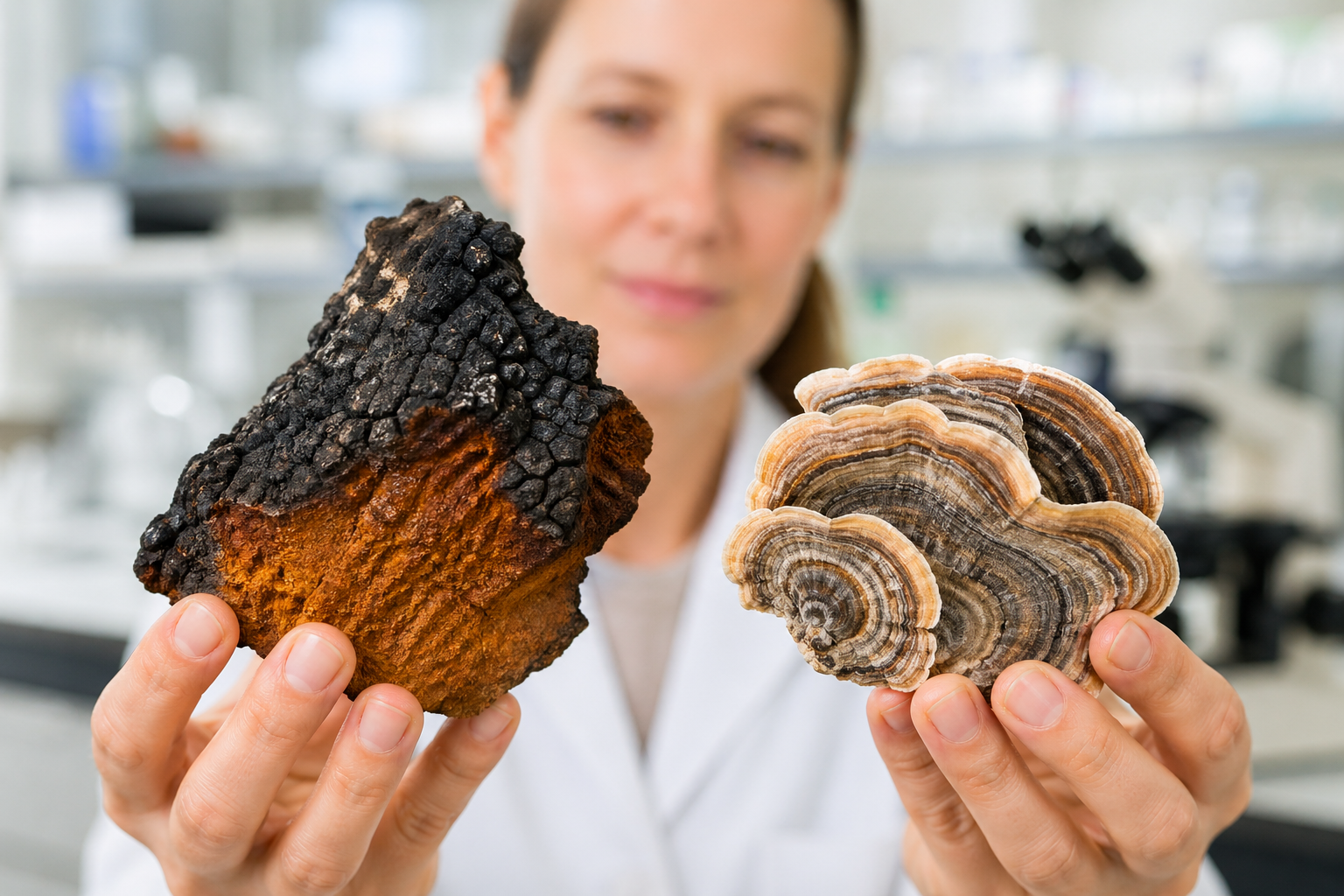
Turkey Tail and Chaga: the most researched Western medicinal mushrooms
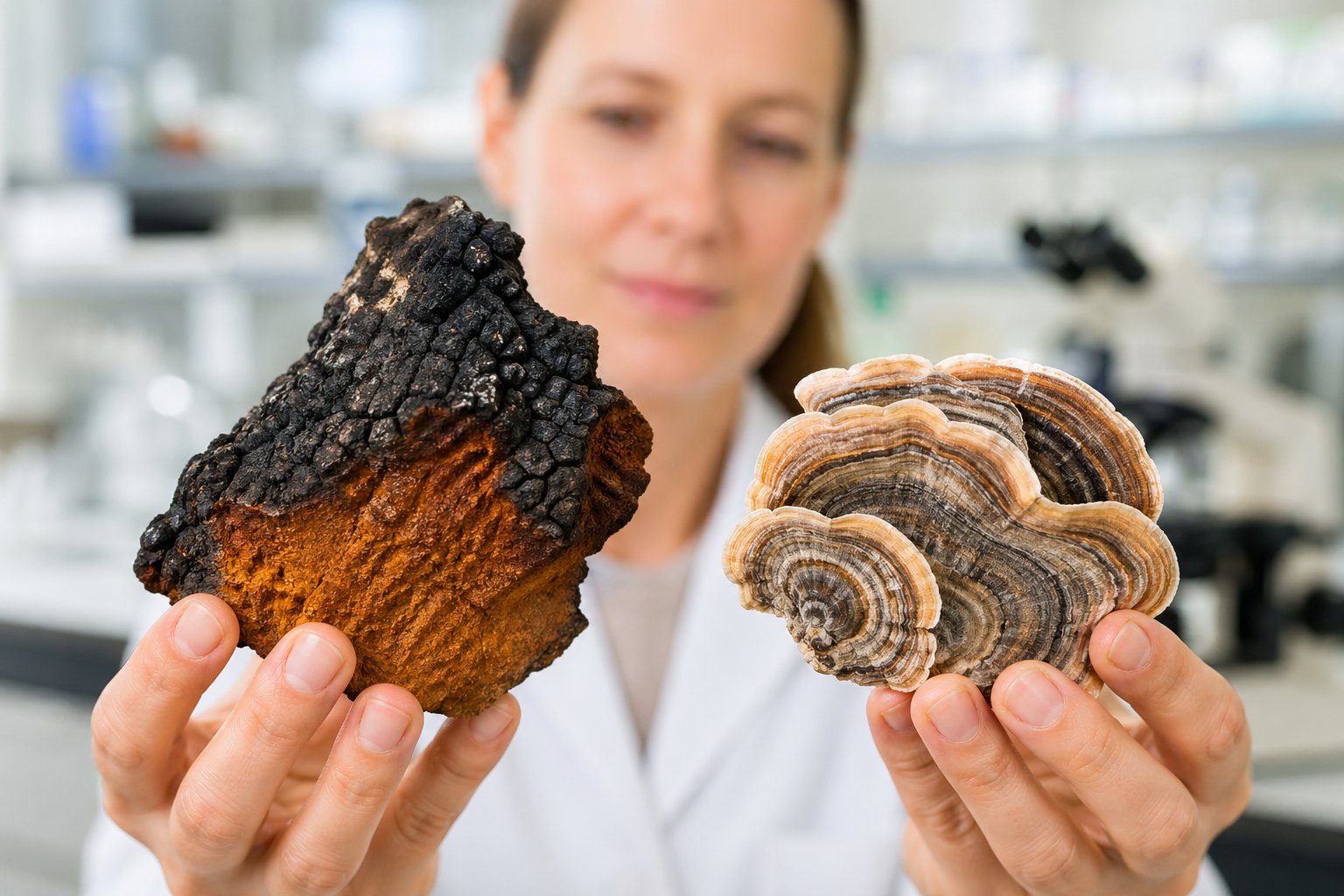
Turkey Tail (Trametes versicolor) and Chaga (Inonotus obliquus) are two medicinal mushrooms with very different profiles. The first has the most robust clinical documentation of all medicinal mushrooms; the second has the highest antioxidant capacity but limited clinical evidence. This article provides a scientific overview of both species.
Turkey Tail (Trametes versicolor)
The best-documented medicinal mushroom
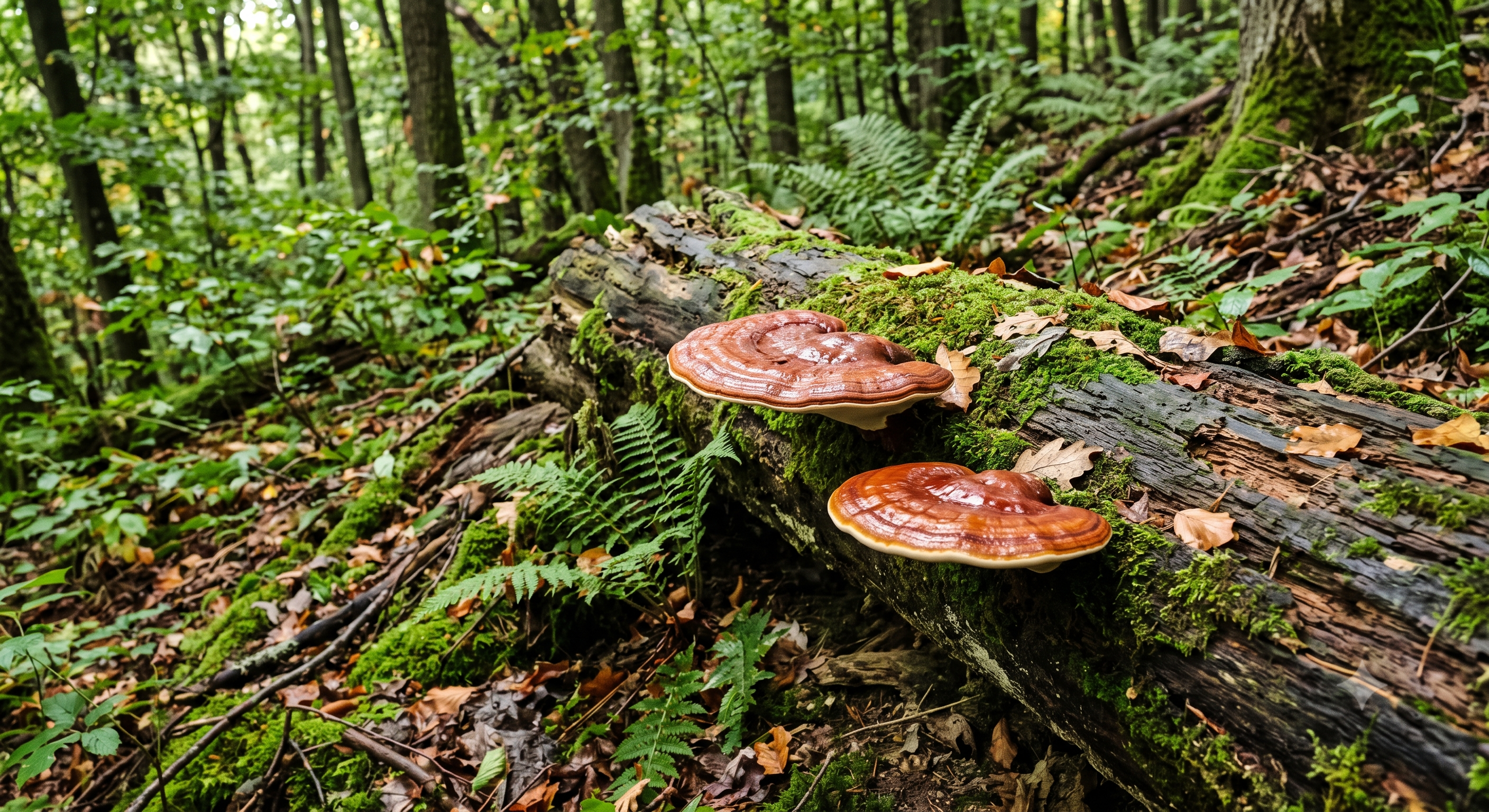
Turkey Tail grows on dead wood all over the world, including Europe and North America. Its name comes from its distinctive coloured pattern, which resembles turkey feathers. In Asian medicine it is known as Yun Zhi (China) or Kawaratake (Japan).
It has the most clinical evidence of all medicinal mushrooms, mainly thanks to extensive Japanese research with the preparation PSK (Polysaccharide-Krestin).
Bioactive substances
PSK (Polysaccharide-Krestin): a protein-bound polysaccharide isolated from the CM-101 strain of Trametes versicolor. PSK contains approximately 62% polysaccharides and 38% protein. The active component is a beta-glucan with β-(1→4) and β-(1→3) linkages.
PSP (Polysaccharopeptide): a similar protein-bound polysaccharide isolated from a different strain (COV-1) in China. PSP has a similar structure and effects to PSK, although they are not identical.
PSK was first isolated in 1965 by the Japanese company Kureha Chemical Industry. In Japan, PSK is registered as a medicine (a pharmaceutical preparation) and has been the subject of extensive clinical research since the 1970s. It is therefore a standalone pharmaceutical preparation, not a food supplement.
Mechanisms of action
PSK and PSP act primarily through immunomodulation:
Activation of NK cells: Ohwada et al. (2006) in the Journal of Experimental & Clinical Cancer Research showed that PSK restores NK cell activity, which is often suppressed in cancer patients. NK cells are key to the immune surveillance of tumour cells.
Maturation of dendritic cells: PSK stimulates the differentiation and maturation of dendritic cells, which improves their ability to present tumour antigens to T lymphocytes and initiates an adaptive immune response.
Cytokine production: PSK increases the production of IL-12, which promotes the differentiation of Th1 cells and the production of IFN-γ. This shift towards a Th1 response is considered favourable in oncology.
Clinical evidence: the most robust documentation
Turkey Tail/PSK has the most extensive clinical data of all medicinal mushrooms:
Gastric cancer
Oba et al. (2007) in the International Journal of Cancer processed pooled data from thousands of oncology patients who received pharmaceutical PSK alongside standard medical care. The study is one of the most cited works on PSK and looked at long-term follow-up. We would remind readers that this is research on a pharmaceutical preparation in a hospital setting, not on a food supplement.
Colorectal cancer
Sakamoto et al. (2006) in Diseases of the Colon and Rectum published a long-term follow-up study of 221 oncology patients. The work examined pharmaceutical PSK (3 g/day orally) given alongside chemotherapy in a hospital setting, and the long-term follow-up of patients. Again, this is research on a pharmaceutical preparation, not on a food supplement.
Cochrane meta-analysis
Eliza et al. (2012): this meta-analysis, published in the Cochrane Database of Systematic Reviews, is the gold standard of systematic reviews. It analysed 13 randomised controlled trials of PSK in cancer patients (8,009 patients in total).
What the meta-analysis looked at:
• It assessed pharmaceutical PSK given alongside chemotherapy in oncology care
• The included studies tracked immune parameters and patients' quality of life
• The results were consistent across the included studies
• Reported side effects were minimal
Important limitations:
• All studies come from Asia (mainly Japan)
• PSK is a pharmaceutical preparation, not an ordinary food supplement
• The research concerned supportive (adjuvant) use alongside standard treatment, not a primary therapy
• Western replication studies are limited
Western research
Bastyr University in Seattle has led several studies of Turkey Tail in breast cancer patients, funded by the NIH (National Institutes of Health):
Torkelson et al. (2012) in ISRN Oncology published a phase I/II study in women after breast cancer treatment. Turkey Tail extract (3–9 g a day) improved immune parameters (NK cells, lymphocytes) without toxicity. However, the study was not designed to assess clinical benefit (survival, relapse).
Chaga (Inonotus obliquus)
The antioxidant champion with limited clinical evidence.
Chaga grows as a parasite on birch trees in cold climates (Siberia, Canada, Scandinavia). It looks more like a black, burnt mass than a typical mushroom. It has been used for centuries in traditional Russian and Siberian medicine, including the traditional preparation as a tea.
Bioactive substances
Beta-glucans: like other medicinal mushrooms, Chaga contains beta-glucans with immunomodulatory effects.
Triterpenes (inotodiol, inotonin): pentacyclic triterpenoid compounds that are the subject of laboratory (in vitro) research.
Betulinic acid:
Chaga absorbs this compound from the birch trees it grows on. Betulinic acid is the subject of experimental laboratory research. Pisha et al. (1995) in Nature Medicine described it in connection with the process of cell apoptosis in cell models (in vitro).
Melanin complex:
Chaga contains large amounts of melanin, which contributes to its antioxidant capacity and may protect against DNA damage induced by ionising radiation.
Antioxidant capacity
Chaga shows the highest antioxidant capacity of the medicinal mushrooms tested:
Babitskaya et al. (2002) measured the antioxidant potential of various medicinal mushrooms and found the highest values in Chaga. Mau et al. (2002) in the Journal of Agricultural and Food Chemistry confirmed these results using ORAC, DPPH and other in vitro tests.
Antioxidants scavenge free radicals and may help ease oxidative stress, which is associated with the ageing of cells and the overall burden on the body. It should be noted, however, that the relationship between antioxidants and health is complex, and supplementation with high doses of synthetic antioxidants may not always be beneficial.
Experimental research
Most research on Chaga comes from in vitro and animal models:
Laboratory (in vitro) research: Chaga extract is the subject of laboratory research on various cell lines. The mechanisms studied relate to processes of cell apoptosis and the cell cycle. These are purely laboratory observations that cannot be transferred to humans.
Animal models: some studies in animal models have looked at cell growth, but these studies are few in number and often use intraperitoneal administration, which is not relevant to oral supplements.
Clinical evidence: a big gap
Unlike Turkey Tail, the clinical evidence for Chaga in cancer patients is extremely limited:
• Most clinical research comes from Russia and the former Soviet Union, with limited availability in English
• Published case reports (individual cases) cannot establish a causal relationship
• There are no randomised controlled trials published in peer-reviewed journals
Balandaykin and Zmitrovich (2015) in the World Journal of Gastroenterology published a case report (a description of a single case) in which Chaga extract was used alongside conventional therapy. However, a case report of a single patient cannot serve as proof of effectiveness, and no conclusions can be drawn from it.
Comparison: Turkey Tail vs. Chaga
Turkey Tail:
• The most robust clinical documentation
• A Cochrane meta-analysis with positive results
• PSK approved in Japan since 1977
• Extensive clinical research (concerning the pharmaceutical PSK)
Chaga:
• The highest antioxidant capacity
• Promising in vitro and animal studies
• A critical lack of clinical evidence in humans
• Traditional use in Russian and Siberian medicine
Practical aspects
Turkey Tail
Commercial Turkey Tail products differ from the pharmaceutical PSK used in clinical trials. PSK is a highly purified and standardised preparation. Ordinary supplements may contain a whole extract with a variable polysaccharide content.
For medicinal purposes, look for products standardised for polysaccharide content (>30%) made from fruiting bodies, not mycelium.
Chaga
Chaga is traditionally prepared as a water extract (tea) by boiling for several hours. Modern supplements use a dual extract (water + alcohol) for a broader spectrum of active substances.
Environmental considerations: wild Chaga grows slowly (10–20 years before it can be harvested), and over-harvesting threatens its populations. Cultivated Chaga has a different chemical profile from wild Chaga.
Turkey Tail and Chaga represent two ends of the spectrum of scientific evidence on medicinal mushrooms:
Turkey Tail (PSK) is the most studied in clinical research of all medicinal mushrooms. In every case, however, this concerns the pharmaceutical preparation PSK studied in a hospital setting alongside standard treatment, not a food supplement. PSK has been registered and used in Japan for decades.
Chaga shows fascinating biochemical properties, including the highest antioxidant capacity, and promising experimental results. Clinical evidence in humans, however, is critically lacking.